
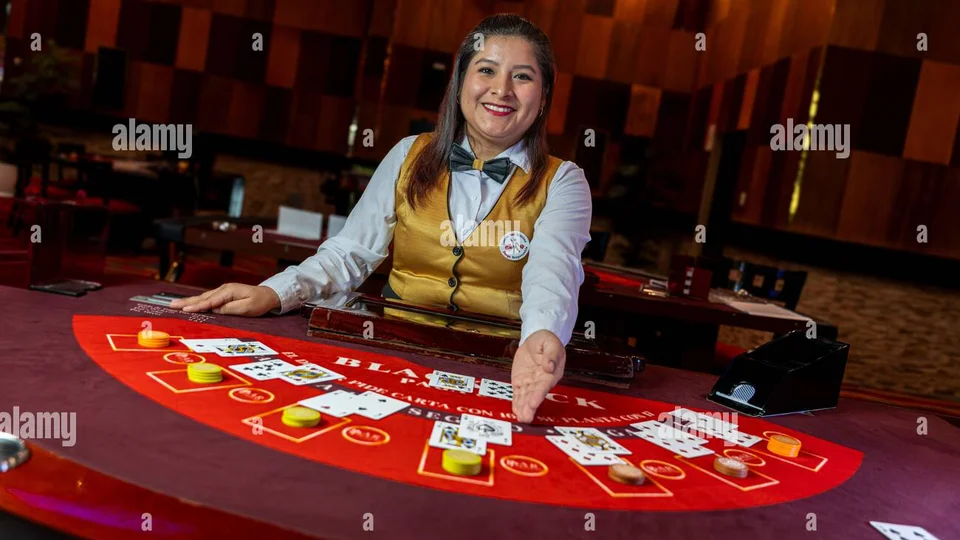
Among all table games on the modern casino floor, Blackjack holds a unique distinction: it is the only game where player decisions directly alter the mathematical house edge. Played poorly, blackjack carries a punishing house advantage exceeding 3% to 5%; executed with mathematically flawless Basic Strategy, the house edge drops to an astonishingly low 0.50% to 0.70% (delivering a theoretical Return to Player of 99.30% to 99.50%). Available on Rajabaji across live studios including Evolution Gaming, Pragmatic Play Live, and Ezugi, live dealer blackjack tables stream real human dealers dealing from physical 8-deck shoes. This comprehensive strategic manual explores the mathematical foundations of basic strategy, soft versus hard totals, doubling and splitting rules, why insurance is mathematically flawed, BDT bankroll allocation, and mobile connectivity guidelines.
Technical Specifications & Table Rules Overview
Live dealer blackjack tables across tier-1 providers follow standardized Vegas and European rule sets:
| Technical Parameter | Specification | Strategic Implication for Players |
|---|---|---|
| Provider Portfolio | Evolution, Pragmatic Play Live, Ezugi | Certified live dealer physical dealing studios |
| Deck Architecture | 8 Standard 52-Card Decks (416 Cards) | Continuous shoe or manual cut-card shuffle at ~50% penetration |
| Theoretical RTP | 99.28% to 99.50% | The highest theoretical return in the live casino when using basic strategy |
| Blackjack Payout | 3 to 2 (1.5:1) | Standard regulatory payout (Avoid any tables offering 6:5 payouts) |
| Dealer Rule on Soft 17 | Dealer Stands on all 17s (S17) | Favorable to player; reduces house edge by ~0.20% vs H17 |
| Double Down Rules | Double on any two initial cards | Full doubling flexibility on 9, 10, 11, and soft hands |
| Split Rules | Split any pair; Split Aces receive 1 card | Standard splitting rules apply across all provider tables |
| Insurance Payout | 2 to 1 | Offered when dealer's upcard is an Ace (House edge: 7.40%) |
| Wager Range (BDT) | ৳100.00 to ৳500,000.00 | Scalable from micro-tables and Infinite tables up to VIP Salon Privé |
Core Hand Values & Dealer Bust Probabilities
The objective of blackjack is not to get as close to 21 as possible; the objective is to beat the dealer's hand without exceeding 21 (busting). Because the dealer is bound by strict, mechanical rules (the dealer has zero decision-making freedom and must hit until reaching 17 or higher), your decisions should always be based on the dealer's face-up card:
[ DEALER UPCARD EVALUATION ]
             │
             ├──► WEAK UPCARD (2, 3, 4, 5, 6) ──► Dealer has a 35% to 42% probability of BUSTING!
             │                                    Strategy: Stand on stiff hands (12-16); let dealer bust!
             │
             └──► STRONG UPCARD (7, 8, 9, 10, A)──► Dealer has high probability of making 17 to 21!
                                                  Strategy: Hit aggressively until reaching at least 17!
Dealer Upcard Bust Probabilities (8-Deck Shoe, S17):
| Dealer Upcard | Probability of Dealer Busting | Player Strategic Posture |
|---|---|---|
| 2 | 35.3% | Moderate Bust Zone: Stand on 13–16 |
| 3 | 37.6% | High Bust Zone: Stand on 13–16 |
| 4 | 40.3% | High Bust Zone: Stand on 12–16 |
| 5 | 42.9% | Critical Bust Zone: Stand on 12–16; Double 9, 10, 11 aggressively |
| 6 | 42.1% | Critical Bust Zone: Stand on 12–16; Double down widest range |
| 7 | 26.0% | Strong Card: Hit until 17+ |
| 8 | 23.9% | Strong Card: Hit until 17+ |
| 9 | 23.3% | Very Strong Card: Hit until 17+ |
| 10 / J / Q / K | 21.4% | Power Card: Hit until 17+; Double only on 11 |
| Ace | 11.7% | Dangerous Card: Never buy insurance; hit until 17+ |
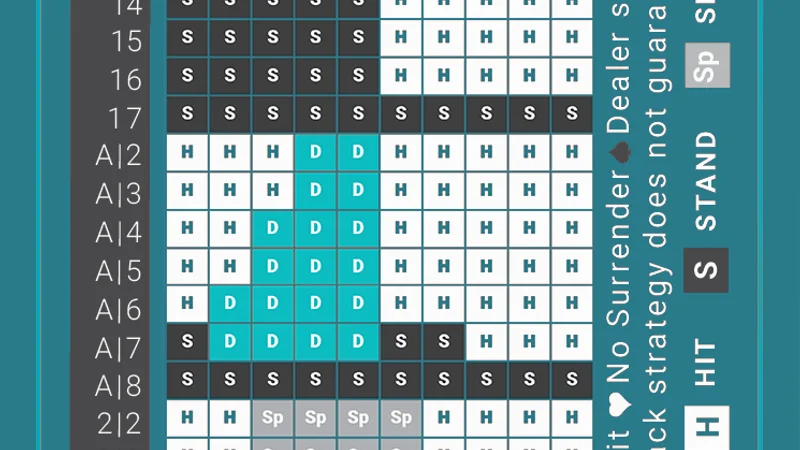
The Basic Strategy Matrix: Hard Totals, Soft Totals & Pairs
Every decision you face in blackjack has a single mathematically optimal action that minimizes the house edge:
                                [ BASIC STRATEGY DECISION TREE ]
                                                │
             ┌──────────────────────────────────┼──────────────────────────────────┐
             ▼                                  ▼                                  ▼
      [ HARD TOTALS ]                    [ SOFT TOTALS (with Ace) ]         [ PAIR SPLITS ]
      • No Ace, or Ace = 1               • Contains Ace counted as 11       • Two identical ranks
      • Risk of busting on next hit      • Cannot bust on single hit        • Creates two separate hands
Hard Totals Action Guide:
- Hard 8 or Lower: Always Hit, regardless of dealer upcard.
- Hard 9: Double Down if dealer shows 3, 4, 5, or 6. Otherwise, Hit.
- Hard 10: Double Down if dealer shows 2 through 9. If dealer shows 10 or Ace, Hit.
- Hard 11: Always Double Down against dealer 2 through 10. (Hit against Ace in S17 games).
- Hard 12: Stand if dealer shows 4, 5, or 6. Hit against 2, 3, and 7 through Ace. (Against 2 and 3, dealer bust rates are slightly lower than 4–6, making hitting 12 mathematically correct).
- Hard 13 through 16: Stand if dealer shows 2 through 6. Hit if dealer shows 7 through Ace.
- Hard 17 through 21: Always Stand.
Soft Totals Action Guide (Hands containing an Ace counted as 11):
- Soft 13 & 14 (A-2, A-3): Double Down against dealer 5 or 6; otherwise, Hit.
- Soft 15 & 16 (A-4, A-5): Double Down against dealer 4, 5, or 6; otherwise, Hit.
- Soft 17 (A-6): Double Down against dealer 3, 4, 5, or 6; otherwise, Hit.
- Soft 18 (A-7): Double Down against dealer 2 through 6. Stand against 7 and 8. Hit against 9, 10, or Ace.
- Soft 19 & 20 (A-8, A-9): Always Stand.
Pair Splitting Action Guide:
- Always Split Aces and 8s: Splitting Aces creates two potential 21s; splitting 8s breaks up a terrible 16 into two workable starting totals of 8.
- Never Split 10s or 5s: Two 10s equal 20, an exceptionally strong winning hand; never break it up. Two 5s equal 10, which should be Doubled Down against 2 through 9.
- Split 2s, 3s, and 7s: Split against dealer 2 through 7; otherwise, Hit.
- Split 4s: Only split against dealer 5 or 6 if Double After Split (DAS) is permitted; otherwise, Hit.
- Split 6s: Split against dealer 2 through 6; otherwise, Hit.
- Split 9s: Split against dealer 2 through 6, and 8 or 9. Stand against 7, 10, or Ace. (If dealer shows 7, your 18 already beats their likely 17, so standing is correct).
The Mathematical Truth About Insurance
When the dealer's face-up card is an Ace, the live software prompts players with an Insurance offer. Insurance costs 50% of your initial wager and pays 2:1 if the dealer's hidden hole card is a ten-value card (10, Jack, Queen, King), giving the dealer a natural 21:
[ 52-Card Deck Model ] ──► 16 Ten-value cards / 51 remaining cards = 31.37% probability
                                     │
                                     ▼
Fair Insurance Payout should be 2.19:1 ──► Casino only pays 2:1!
This gives the casino an enormous 7.40% HOUSE EDGE on the insurance wager!
Strategic Rule: Never Take Insurance
Unless you are an expert card counter tracking deck compositions, buying insurance is mathematically disadvantageous. Over hundreds of hands, taking insurance will significantly erode your bankroll. Decline insurance unconditionally, every single time.
Bankroll Management & Table Sizing in Bangladeshi Taka (BDT)
Blackjack requires capital reserves because basic strategy frequently mandates Doubling Down and Splitting Pairs, which temporarily doubles or triples your financial commitment on a single hand:
[ The 3x Round Reserve Rule ]
If you wager ৳200 BDT base stake:
• You may be dealt 8-8 against a dealer 6 (Split = +৳200 BDT)
• Hand 1 receives a 3 (Total 11 ──► Double Down = +৳200 BDT)
• Total capital invested on one round = ৳600 BDT!
Staking Strategy Profiles:
| Player Profile | Session Bankroll | Table Minimum | Maximum Bet per Hand | Playstyle Focus |
|---|---|---|---|---|
| Casual Disciplined | ৳3,000 BDT | ৳100 BDT | ৳100 BDT (Flat Bet) | Strict basic strategy adherence; low house edge grinding |
| Tactical Growth | ৳10,000 BDT | ৳200 BDT | ৳200 – ৳400 BDT | Follows basic strategy; uses positive progression after 3 consecutive wins |
| VIP High Roller | ৳50,000+ BDT | ৳1,000 BDT | ৳1,000 – ৳2,500 BDT | High table liquidity; private Salon Privé tables with custom cut-card depth |
Infinite Blackjack vs. 7-Seat Classic Tables
On Rajabaji, live dealer blackjack is available in two primary configurations:
- 7-Seat Classic Tables: Traditional physical tables where exactly seven players occupy dedicated seats. Cards are dealt directly to individual seat boxes. If all seats are full, you must use the "Bet Behind" feature or wait for an open seat.
- Infinite / One-to-Many Tables (Infinite Blackjack, Free Bet Blackjack): A single community hand is dealt to all connected players simultaneously, but each player makes their own independent hit, stand, double, or split decision. Infinite tables never have full seats and feature lower minimum bet thresholds (starting from ৳100 BDT).
Mobile Latency & Decision Timers on Bangladeshi Networks
Live blackjack gives players approximately 10 to 12 seconds to make their tactical decisions. Follow these technical safeguards:
- Pre-Decision Buttons: Modern Evolution and Pragmatic Play tables feature pre-decision buttons allowing you to select "Hit", "Stand", or "Double" while previous players at the table are still making their moves. Using pre-decision ensures your action registers even if a sudden mobile data lag spike occurs.
- Auto-Stand Setting: Review table settings to ensure your hand does not auto-stand on an accidental double-tap.
Responsible Gaming Safeguards
The steady, engaging nature of live blackjack can lead to long gaming sessions:
- Establish a clear daily stop-loss limit (e.g., 30% of your allocated bankroll) and exit immediately if reached.
- Never increase base wagers impulsively after a losing hand; basic strategy relies on steady execution across hundreds of deals.
- Treat blackjack strictly as skill-based entertainment, not as guaranteed income.
- If you find yourself wagering beyond your limits or feeling stressed, seek free, confidential help from Gambling Therapy or GamCare, and utilize Rajabaji's responsible gaming tools.
Related Guides & Cashier Walkthroughs
- Speed Baccarat 27-Second Tactics
- Sexy Baccarat Live Tables & Roadmaps
- Evolution Lightning Roulette Multiplier Odds
- Ezugi Teen Patti Rules & Hand Rankings
- bKash Deposit & Cashout Walkthrough
- Nagad Withdrawal Verification Process
- Official Account Registration & Verification
- Mobile APK Download & Installation
- Regulated under licensing standards by Gaming Control Curacao and Curacao eGaming. Fast local cashier deposits supported by bKash, Nagad, and Rocket. Player welfare assistance accessible via Gambling Therapy and GamCare.
Ready to Experience Verified Gameplay?
Join thousands of Bangladeshi players on Rajabaji. Instant deposits via bKash, Nagad & Rocket, 100% welcome match up to ৳18,000, and certified fast payouts.
Claim ৳18,000 Welcome Bonus Now ⚡Frequently Asked Questions
When playing standard 8-deck live blackjack where the dealer stands on soft 17 and pays 3:2 on natural blackjacks, following basic strategy perfectly reduces the house edge to approximately 0.50% to 0.70% (an RTP of 99.30% to 99.50%).
No. Insurance carries a substantial house edge of approximately 7.40%. Even Money (offered when you hold a natural blackjack and the dealer shows an Ace) gives up long-term value. Mathematically, you should decline both offers every time.
While the dealer shows a low card, dealer bust rates against a 2 (35.3%) and 3 (37.6%) are noticeably lower than against 4, 5, or 6 (up to 42.9%). Computer simulations show that hitting a 12 loses less money in the long run than standing against a 2 or 3.
A hard 16 is mathematically the worst starting hand in blackjack. By hitting or standing, you lose over 60% of hands. Splitting two 8s breaks up that disadvantageous 16 into two separate hands starting with an 8, each of which has a strong chance of drawing a 10-value card to reach 18.
A Soft Hand contains an Ace that is currently counted as 11 without causing the hand to bust (e.g., Ace + 6 = Soft 17). A Hard Hand either does not contain an Ace, or contains an Ace that must be counted as 1 to prevent busting (e.g., 10 + 6 = Hard 16, or Ace + 7 + 9 = Hard 17). Soft hands cannot bust on a single hit.
A 3:2 payout awards ৳150 BDT on a ৳100 BDT wager for a natural blackjack. A 6:5 table awards only ৳120 BDT for that same win. That seemingly small difference increases the house edge by a massive 1.4%, heavily favoring the casino. Always choose tables with standard 3:2 payouts on Rajabaji.